

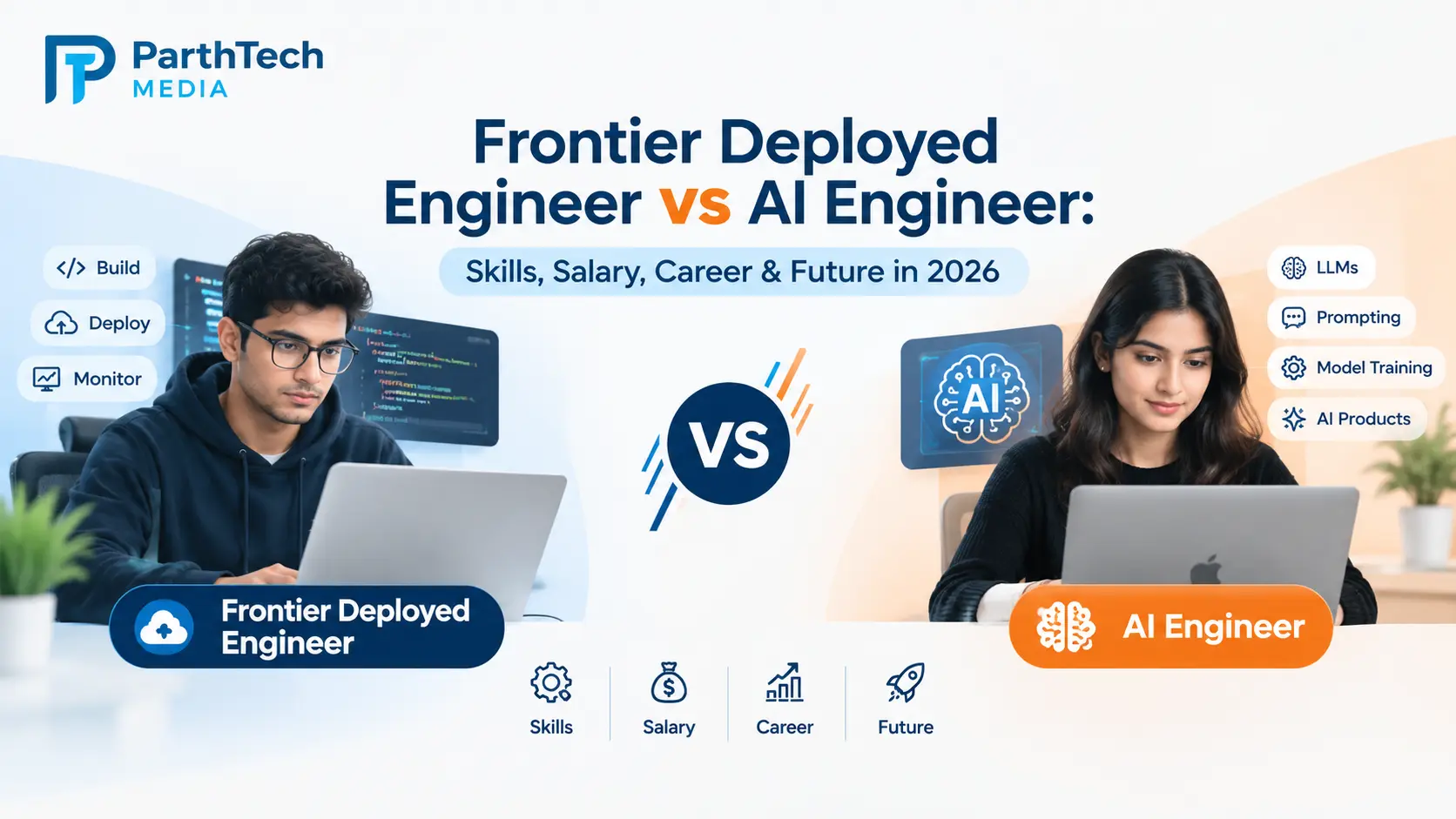
Anthropic has just put $100 million behind a new category of enterprise AI talent. On October 2, 2026, the company announced Claude Frontier Academy with a target of training 10,000 Frontier Deployed Engineers by the end of 2027.
The first participating organizations include Accenture, Bain, Capgemini, Commonwealth Bank of Australia, Deloitte, McKinsey, Morgan Stanley and Novo Nordisk. The programme combines hands-on enterprise deployment training with a 12-week residency in which engineers lead a real Claude implementation inside their organization.
But what exactly is a Frontier Deployed Engineer? Is it simply another name for an AI Engineer? Is it the same as a Forward Deployed Engineer? And which skills should students and working professionals develop if they want to prepare for this emerging career category?
The short answer is that an AI Engineer primarily builds AI systems, while a deployed AI engineer combines software and AI engineering with business-process understanding, enterprise integration, security, adoption and responsibility for making AI work inside a real organization.
That difference could become increasingly important as businesses move from experimenting with AI chatbots toward deploying AI agents capable of completing real business processes.
Frontier Deployed Engineer vs AI Engineer: Quick Answer
A Frontier Deployed Engineer, as Anthropic currently uses the term, is an engineer trained to take frontier AI from a business problem to a secure, production-ready system that employees can actually use.
An AI Engineer is a broader technical role focused on designing, building, integrating, testing and deploying artificial intelligence or machine-learning systems.
There is significant overlap between the two roles. However, the deployed-engineer role usually extends beyond building the technology itself. It can involve discovering the business problem, understanding existing workflows, connecting enterprise systems, navigating security reviews, training users and measuring whether the AI implementation produces a meaningful business result.
Anthropic describes its Forward Deployed Engineering model in similar terms: taking Claude from an initial idea to a functioning production system.
Frontier Deployed Engineer vs AI Engineer Comparison
| Area | Frontier/Forward Deployed Engineer | AI Engineer |
|---|---|---|
| Main objective | Make AI solve a real business problem in production | Build and operate AI systems |
| Primary focus | AI + software + business + deployment | AI/ML + software engineering |
| Customer interaction | Very high | Usually low to medium |
| Business process understanding | Essential | Helpful |
| LLM knowledge | Essential in modern AI FDE roles | Increasingly essential |
| AI agents | Core skill | Increasingly common |
| RAG | Important | Important |
| Python | Usually essential | Usually essential |
| APIs and integrations | Critical | Important |
| Databases | Important | Important |
| Cloud platforms | Important | Important |
| ML/deep learning | Useful; depth depends on role | Often more important |
| PyTorch/TensorFlow | May or may not be required | Frequently required |
| Security/governance | Major responsibility in enterprise deployments | Usually shared with other teams |
| Product thinking | Very important | Important |
| Stakeholder communication | Critical | Useful to important |
| Workflow redesign | Core responsibility | Usually secondary |
| Production deployment | Core responsibility | Core responsibility |
| Adoption/change management | Often part of the job | Usually outside the main responsibility |
| Success measurement | Business outcomes + technical reliability | Technical/model/product performance |
| Typical environment | Customer or enterprise deployment | Product, engineering or AI team |
| Best profile | Technical generalist with business judgment | AI-focused technical builder |
Frontier vs Forward Deployed Engineer: What Is the Correct Term?
This naming distinction is important because students may see both terms online.
Anthropic’s October 2026 Academy calls its final credential the Claude Frontier Deployed Engineer badge. However, Anthropic itself continues to hire professionals under the title Forward Deployed Engineer.
The wider technology industry also primarily uses the term Forward Deployed Engineer, commonly shortened to FDE. Current roles using this title can be found across companies such as Accenture, Databricks, Cursor, Indegene and several AI startups.
The easiest way to understand the difference is that Frontier Deployed Engineer is currently Anthropic’s training and credential terminology, while Forward Deployed Engineer is the more established industry job title.
Both represent a similar idea: technically strong engineers who work close to customers and business operations and convert powerful AI technologies into systems that work reliably in production.
Why Is Anthropic Investing $100 Million in Frontier Deployed Engineers?
The reason is not that businesses lack access to advanced AI models. Large organizations can already use Claude, GPT, Gemini and many other frontier models.
The more difficult problem is implementation.
A company may purchase access to a powerful model but still struggle to identify the correct use case, connect the model with internal systems, protect sensitive information, design appropriate human approvals, satisfy security teams and encourage employees to adopt the final solution.
Anthropic believes companies increasingly need engineers who can handle that full journey. That is why the company has committed $100 million to Claude Frontier Academy and plans to train 10,000 Frontier Deployed Engineers by the end of 2027.
Dividing $100 million by the 10,000-engineer target produces a theoretical figure of $10,000 per targeted engineer. However, this should not be interpreted as a direct payment or fixed training budget for every participant because Anthropic’s commitment covers the broader Academy initiative.
How Claude Frontier Academy Works
Claude Frontier Academy is significantly different from a normal online AI certification course.
Participants begin with a multi-day, in-person programme where they work with Anthropic engineers and licensed instructors. They go through a simulated enterprise AI deployment that covers the process from selecting a useful business problem through system implementation, security review and final handover.
Participants then complete a graded practical exercise. Those who pass can earn a Claude Resident Engineer badge.
The next stage is a 12-week residency. During this period, participants lead an actual Claude deployment inside their own organization while receiving support from Anthropic engineers and the broader cohort.
After a second assessment, successful participants can earn the Claude Frontier Deployed Engineer badge. Anthropic expects the first Frontier Deployed Engineer credentials to be awarded in early 2027.
Can Indian Students Join Claude Frontier Academy?
Not currently through a public student application.
Claude Frontier Academy is not positioned as a normal student certification programme. Participating organizations nominate suitable engineers to join the programme.
The initial cohorts are being conducted in San Francisco, New York and London. As of October 3, 2026, Anthropic has not announced a public India cohort or an open application path specifically for Indian students.
The programme is also aimed at experienced, hands-on software engineers rather than beginners. Anthropic says suitable participants should have strong software fundamentals, experience building with LLMs, experience helping people adopt AI and a record of solving important business problems.
Interestingly, previous experience building AI agents is not mandatory for the Residency.
For students, the more important message is therefore not how to get into Anthropic’s programme today. The important signal is the type of talent leading AI companies believe businesses will need in the next few years.
What Does a Frontier or Forward Deployed Engineer Actually Do?
Imagine a bank wants to automate part of its loan-document review process using AI.
A traditional AI project might begin with an AI Engineer being asked to create a document extraction or classification system. A Forward Deployed Engineer may become involved even earlier by first understanding how the entire loan-review process works.
The engineer may study where documents arrive, which systems store them, which information is sensitive, what decisions can safely be automated, where humans need to approve a result and what happens when the AI is uncertain.
The FDE also needs to understand how the new AI system will connect to existing banking software, what security review is required and how success will eventually be measured.
Only after understanding those questions does the technical design become clear.
The engineer may then build agents, APIs, RAG systems, MCP servers, workflows and integrations; deploy them; test them with users; monitor failures; and improve the process until the system generates measurable business value.
Anthropic’s own Forward Deployed Engineer role includes building production applications inside customer environments and creating technical components such as MCP servers, sub-agents and agent skills.
What Does an AI Engineer Do?
An AI Engineer typically focuses more heavily on the technology layer.
The role can include designing and deploying AI applications, training or fine-tuning machine-learning models, integrating large language models into products and creating systems that automate complex tasks.
Modern AI Engineers may work on LLM applications, RAG systems, embeddings, vector databases, AI agents, model evaluation, inference optimization, data pipelines, MLOps, APIs and production monitoring.
However, the title is extremely broad. One AI Engineer may work deeply on GPU inference optimization, while another develops a RAG application or integrates Claude, Gemini or GPT into an enterprise product.
This is why AI Engineer is better understood as a broad career category rather than one narrowly defined job description.
The Biggest Difference: Building AI vs Delivering a Business Outcome
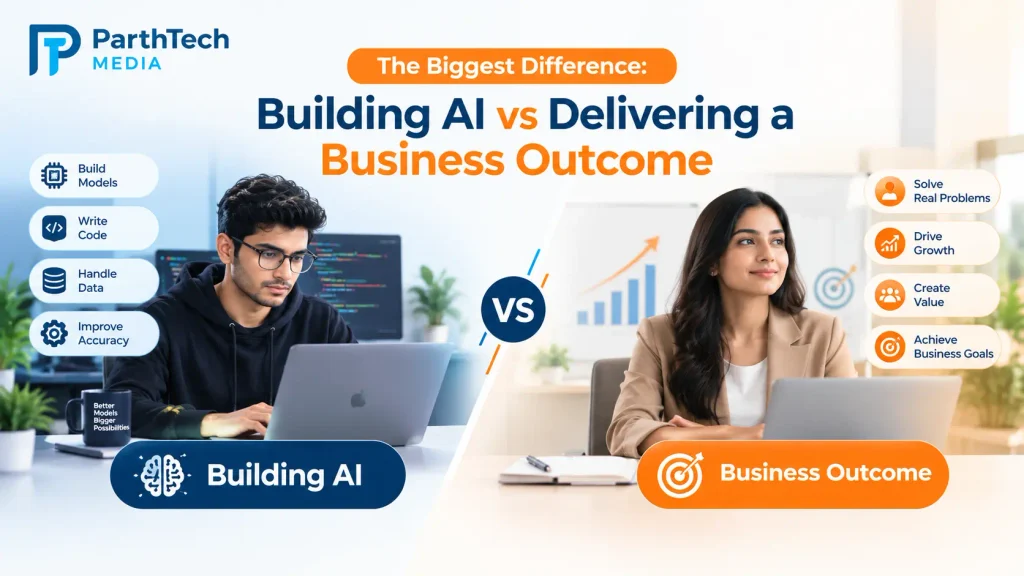
The distinction can be simplified into one idea.
An AI Engineer is often primarily responsible for the AI system, while a Forward Deployed Engineer may be responsible for whether that system successfully produces the desired business outcome.
Suppose an AI solution achieves 95% technical accuracy. That may be an excellent engineering result.
However, if only 20% of employees use the tool, if the security department blocks production access, if the software does not connect with the company’s existing systems or if employees still perform the same manual process afterward, the business problem has not actually been solved.
That is why deployed engineers need a combination of technical knowledge, product thinking, business understanding, communication skills and implementation ability.
Forward Deployed Engineer Roles Are Already Appearing in India
Forward Deployed Engineering is no longer purely a Silicon Valley concept.
Accenture has advertised Forward Deployed Engineer roles in India focused on deploying AI workflows and architectures across enterprise platforms and integrating AI models with broader business technology.
Some Accenture openings specifically reference areas such as AI Agents & Workflow Integration, Generative AI and Gemini-related implementations.
Databricks describes its AI Forward Deployed Engineering organization as a specialized customer-facing team that helps companies build and productionize first-of-their-kind AI applications. Relevant skills include RAG, multi-agent systems, Text2SQL, fine-tuning and production GenAI evaluation.
Cursor has also advertised a Forward Deployed Engineer position covering Indian markets such as Bengaluru, New Delhi and Mumbai. The role includes working directly with customer engineering teams, creating production workflows, defining success metrics, monitoring deployments and feeding customer insights back into product development.
Indegene’s Bengaluru Forward Deployed Engineering positions similarly emphasize AI agents, workflow integration and production AI systems in healthcare and life sciences.
These listings show that deployed AI engineering is already becoming part of India’s enterprise AI market.
AI Engineer Jobs Are Still Much More Common
Forward Deployed Engineer remains a comparatively new and specialized job title.
AI Engineer is already a much broader category. LinkedIn currently shows 11,000+ AI Engineer-related openings in India, although job-board counts change frequently and often include related job titles.
LinkedIn’s 2026 Jobs on the Rise analysis also identifies AI engineering among India’s rapidly growing technical career areas.
According to LinkedIn’s profile analysis, professionals entering AI Engineer roles had a median of around two years of prior experience, with Software Engineer, Data Scientist and Data Analyst among common previous positions.
Major hiring hubs included Bengaluru, Hyderabad and Delhi.
For students entering the market today, AI Engineer therefore remains the broader and easier-to-understand career category. Forward Deployed Engineering is better seen as an emerging specialization that software or AI engineers can move toward after developing strong production skills.
AI Engineer vs FDE Skills
The technical overlap between these two careers is significant.
Both can require Python, APIs, cloud platforms, databases, LLMs, RAG, AI agents, evaluation systems and production deployment knowledge.
A strong modern AI Engineer may need Python, SQL, machine learning, LLM APIs, prompt engineering, vector databases, embeddings, agent frameworks, MLOps, Docker, Git, cloud infrastructure and system design. Depending on the position, knowledge of PyTorch, TensorFlow, fine-tuning, inference optimization and mathematics may also be important.
An FDE typically needs many of those same technical skills but combines them with additional capabilities such as business-process mapping, stakeholder discovery, enterprise architecture, workflow automation, systems integration, security reviews, governance, human-in-the-loop design and success measurement.
This is why Forward Deployed Engineering is often described as sitting at the intersection of engineering, product, consulting, AI and customer success.
Why AI Agents Make FDE Skills More Valuable
Traditional chatbots mostly operate inside a single interface.
AI agents can interact with multiple systems.
An enterprise AI agent could read incoming emails, retrieve customer data, query databases, update a CRM, generate a document, trigger an API, request human approval and then continue the workflow automatically.
Once AI starts operating across real software, the complexity increases dramatically.
The model is only one part of the system. Engineers must also understand business rules, permissions, APIs, databases, security, observability, human approvals, error handling and production monitoring.
This is precisely where forward-deployed AI engineers become valuable.
India’s AI Workforce Is Already Moving in This Direction
Microsoft’s 2026 Work Trend Index provides an interesting signal about how advanced AI usage is developing in India.
Microsoft reports that 32% of Indian AI users qualify as “Frontier Professionals,” compared with a global average of 16%. These are people using AI agents for multi-step workflows, redesigning work around AI and helping organizations develop more advanced AI practices.
In other words, the reported share for India is twice the global average.
Microsoft also found that 78% of Indian AI users said AI enabled them to perform work that was not possible a year earlier, compared with 58% globally. Among India’s Frontier Professionals, that number increased to 85%.
This does not mean that 32% of India’s entire workforce is performing advanced AI engineering. The number applies to AI users included in Microsoft’s research.
However, it does indicate that more professionals are progressing from basic AI usage toward workflow automation and agentic work.
Anthropic’s $100 Million Programme Is Part of a Larger AI Skills Shift
Claude Frontier Academy is not Anthropic’s first skills initiative.
The company says the broader Claude Partner Network already includes professionals across 46,000 firms. It also reports that more than 175,000 Claude certifications have been earned and almost 4,000 people have completed Basecamp, an immersive training programme inspired by Anthropic’s internal Applied AI training.
The new 10,000-engineer programme is designed to create a smaller group of engineers capable of leading high-impact AI deployments.
That distinction is important.
Knowing how to use an AI tool is different from knowing how to redesign a workflow, integrate systems, secure the solution and get employees to use it.
The second capability is likely to become more valuable as enterprise AI adoption increases.
Frontier Deployed Engineer Salary vs AI Engineer Salary
Salary comparisons require caution because Forward Deployed Engineering is still a relatively small category and compensation varies significantly by country, company and experience.
Anthropic currently advertises a US Forward Deployed Engineer role in locations including New York, San Francisco and Seattle with a base salary range of around $280,000 to $320,000 per year.
That should not be interpreted as an average global FDE salary. Anthropic is one of the world’s leading frontier AI companies and its compensation is far above what most companies would offer.
Forward Deployed Engineer Salary in India
India already shows a very broad compensation range.
One Bengaluru Forward Deployed Engineer listing surfaced with an employer-provided salary range of approximately ₹10 lakh to ₹80 lakh per year, while another India-based early-career FDE opportunity advertised around ₹9 lakh to ₹12 lakh per year.
These examples demonstrate how immature the salary market still is for this title.
There is currently no reliable single number that can accurately represent a national average Forward Deployed Engineer salary in India.
AI Engineer Salary in India
AI Engineer salaries also vary widely.
Current openings have included positions offering around ₹20–30 lakh per year, while some founding or highly specialized AI Engineer opportunities have advertised ₹50–70 lakh per year.
Other AI Engineer or AI Developer listings may fall closer to the ₹6–22 lakh range depending on experience, location, employer and technical requirements.
The important conclusion is that both careers can produce strong compensation when professionals can build reliable production AI systems.
FDE compensation can become particularly attractive when the engineer combines technical expertise with responsibility for strategically important enterprise deployments.
Which Role Requires More Coding?
Both roles require coding.
An FDE should not be confused with a consultant who only understands AI terminology.
Modern FDE job descriptions repeatedly ask for production software development experience, Python, APIs, databases, system architecture, AI agents and deployment knowledge.
The difference is often in the type of engineering work being performed.
An AI Engineer might spend significant time improving an inference system, fine-tuning a model, optimizing retrieval quality or designing an internal AI platform.
An FDE might spend more time connecting multiple existing systems, creating a custom agent, building APIs and solving unexpected technical problems inside a customer’s environment.
This makes the FDE more of a technical generalist-builder.
Does an FDE Need Machine Learning?
Yes, but not every Forward Deployed Engineer needs the same machine-learning depth as an AI researcher or highly specialized ML Engineer.
For many modern enterprise AI deployments, understanding LLM behaviour, RAG, context engineering, evaluation, tool calling, AI agents, APIs and production reliability may be more important than knowing how to train a neural network from scratch.
Anthropic’s Residency guidance reflects this difference.
The company expects participants to have strong software fundamentals and experience building with large language models, but it does not require previous experience building AI agents.
Does an FDE Need Prompt Engineering?
Prompt engineering is useful, but prompt engineering alone is nowhere near enough.
A real enterprise AI system can require prompt design, context engineering, structured outputs, RAG, tool calling, authentication, databases, workflow orchestration, monitoring, fallbacks, human approvals and security controls.
This is why learning how to write better ChatGPT prompts should not be confused with preparing for professional AI engineering.
Prompting is one component of a much larger system.
Can a Fresher Become a Forward Deployed Engineer?
It is possible, but generally more difficult than entering a junior software or AI engineering position.
Many Forward Deployed Engineer roles prefer experienced professionals because the employee is expected to make independent technical decisions inside customer environments.
Current Indian FDE advertisements range from positions open to relatively early-career candidates to roles asking for two, three, five or more years of relevant experience.
A student can still begin developing the right skill set today.
A realistic path could be Student → Software/Automation/AI Engineer → Production AI Projects → Customer-Facing AI Deployments → Forward Deployed Engineer.
The important point is that FDE does not necessarily need to be someone’s first job.
How to Prepare for a Forward Deployed Engineer Career
The best preparation is to stop treating an isolated chatbot as a complete AI project.
Instead, select a real process and build an end-to-end solution around it.
For example, imagine that a college receives enquiries through WhatsApp. The AI system needs to understand student intent, answer common questions, collect lead information, store it in a CRM, schedule a demo, notify the appropriate employee, handle unusual questions and allow a human counsellor to take over when required.
Now the project involves much more than prompting an LLM.
The developer must think about data structures, APIs, business rules, databases, automations, security, costs, failures, logging, permissions and measurable business results.
A strong Forward Deployed Engineering portfolio project should clearly show the journey from business problem to existing workflow, AI opportunity, architecture, data, model, tools, automation, security, human approval, evaluation, deployment and final business metric.
That kind of portfolio evidence is more meaningful than simply showing twenty unrelated AI demos.
AI Engineer or Frontier Deployed Engineer: Which Career Should Students Choose?
Most beginners do not need to decide immediately.
The first goal should be becoming capable of building useful AI systems.
That means learning strong software fundamentals, Python, APIs, databases, Git, cloud basics, large language models, RAG, AI agents, automation and deployment.
Once those fundamentals are in place, students can develop stronger business and customer-facing skills.
The more effectively someone combines engineering capability, AI fluency and business understanding, the more career options they will have.
An AI Engineer can later become a Forward Deployed Engineer. An experienced FDE can move into AI architecture, solutions architecture, product engineering, technical consulting, enterprise AI transformation or engineering leadership.
AI Engineer vs FDE: Which Role Is Harder?
The difficulty is different.
A research-heavy AI Engineer role can demand deeper mathematics, machine-learning theory and model-level knowledge.
Forward Deployed Engineers may face a different type of complexity: ambiguity.
A customer may not know exactly what problem needs to be solved. The company’s data may be messy, its software may be old, security teams may reject the first proposed solution and employees may resist changing the way they work.
The FDE has to solve technical and organizational problems at the same time.
That requires judgment, adaptability and communication in addition to pure engineering ability.
Why Communication Skills Matter More in AI Engineering
Forward Deployed Engineers frequently communicate with developers, business teams, managers, cybersecurity departments and senior executives.
They may need to explain why a proposed AI use case is unrealistic, why one decision should remain human-controlled, why an agent needs certain permissions or why an AI prototype is not ready for production.
Communication therefore becomes part of the technical job.
Microsoft’s India findings reinforce the same trend. Among Indian AI users surveyed, 63% prioritized quality control of AI output while 59% ranked critical thinking as a top skill.
This means future AI professionals will not only be expected to use intelligent systems. They will also need to evaluate those systems and know when not to trust them.
Domain Knowledge Could Become a Major Career Advantage
AI models themselves are becoming easier to access.
Understanding how an industry actually operates remains difficult.
An engineer who understands banking, healthcare, education, ecommerce, manufacturing or marketing can identify more useful automation opportunities than someone who understands only the AI model.
That is why many enterprise FDE positions mention domain expertise.
Anthropic’s own FDE hiring information notes that experience in sectors such as financial services, healthcare and life sciences can be valuable.
The future may therefore reward combinations such as AI + Healthcare, AI + Finance, AI + Marketing, AI + Cybersecurity, AI + Manufacturing and AI + Education.
For many professionals, the domain skill may ultimately become as important as the AI skill.
Is AI Engineering Becoming Less Important?
No.
The rise of Forward Deployed Engineering actually creates more demand for strong AI Engineering.
Someone still needs to create the underlying models, AI platforms, retrieval systems, data infrastructure, agent frameworks, evaluation systems and developer tools that FDEs later deploy.
The more likely future is greater specialization.
AI Researchers improve foundational technology. ML Engineers develop machine-learning systems. AI Engineers build AI products and platforms. Forward Deployed Engineers integrate those technologies into specific organizations and workflows.
AI Product Managers determine what should be built, while AI security and governance professionals help ensure these systems operate safely.
One job is not replacing all the others.
The AI ecosystem is expanding.
The Career Market Is Moving Toward Skill Stacks
LinkedIn’s 2026 India job analysis shows AI-related technical roles gaining momentum while AI capabilities are also spreading into jobs outside traditional technology functions.
LinkedIn identifies skills such as Large Language Models, PyTorch and Deep Learning among common AI Engineer capabilities and reports software engineering and data roles as frequent pathways into AI engineering.
The broader lesson is that employers increasingly value combinations of skills.
Knowing Python alone is not enough. Knowing an AI model alone is not enough. Knowing business processes without being able to build a system is not enough for a technical deployed-engineering role.
The strongest candidates sit at the intersection of multiple skill areas.
What Happens to These Roles by 2030?
The broader labour-market outlook supports continued demand for advanced AI capabilities, even though job titles will continue evolving.
The World Economic Forum estimates that major economic and technological changes could create 170 million jobs by 2030 while displacing around 92 million, resulting in a net gain of approximately 78 million jobs.
AI and machine-learning specialists are among the fastest-growing job categories.
At the same time, employers expect approximately 39% of workers’ existing core skills to change or become outdated between 2025 and 2030.
That is why learning one fixed software stack is unlikely to be a sustainable career strategy.
The technology will change repeatedly.
The ability to understand problems, learn new systems and build solutions will remain valuable.
Five Major Changes Coming to AI Engineering Careers
The first shift is from AI demos to production AI. Many companies have already experimented with chatbots and copilots, but the next challenge is connecting AI with real operations and measurable outcomes.
The second change is from single AI assistants to AI agents. Engineers will increasingly build systems capable of planning, using tools, accessing software and completing multi-step processes.
The third shift is from model-centric thinking to workflow-centric thinking. Having the best AI model does not automatically create the best business system. Data quality, integrations, permissions, evaluation, error handling and human oversight can matter just as much as model intelligence.
The fourth change is the growth of hybrid technical-business roles. Forward Deployed Engineer is one example of a career that combines software engineering, AI, consulting, product thinking and customer interaction.
The fifth shift is from certificates to evidence of execution. Employers will increasingly want proof that candidates can build, deploy and improve real AI systems rather than simply list AI tools on a résumé.
Why Forward Deployed Engineering Matters for India
India could have a particularly strong opportunity in this career category because the country combines a massive technology-services workforce with rapidly growing global demand for enterprise AI implementation.
India’s technology-services sector has spent decades implementing ERP systems, cloud platforms, websites, enterprise software and digital transformation projects for companies around the world.
The next major implementation wave could involve AI agents, enterprise copilots, autonomous workflows, multimodal AI systems and AI-connected business processes.
Forward Deployed Engineering fits naturally into that model.
It may become particularly important for IT-services companies, consulting firms, Global Capability Centres, startups and AI automation agencies.
The opportunity could also extend beyond traditional technology hubs as AI deployments spread through remote teams and regional businesses.
What Should Students Learn in 2026?
Students interested in this field should avoid chasing every new AI application that becomes popular.
Instead, they should build a durable technical foundation.
A practical progression would be to start with programming fundamentals, then learn Python, APIs, databases, Git and cloud basics. After that, students can move into large language models, prompt and context engineering, RAG, AI agents, workflow automation, MCP or tool integrations, evaluation, security and deployment.
The next step is equally important: understanding real business processes.
The strongest learning happens when a student builds something used by actual people.
A deployed project used by ten real users can teach more about reliability, failures and user behaviour than a hundred tutorial projects.
Practical FDE-Style Project Example for Students
Instead of creating a simple FAQ chatbot, a student could build an AI admissions automation system.
The system might receive enquiries, understand a student’s intent, answer course questions, qualify leads, collect contact details, schedule counselling sessions, save information to a CRM, notify counsellors, generate follow-up messages and transfer the conversation to a human whenever required.
The student should then document how the complete system works.
What business problem was being solved? Which steps were automated? Which AI model was used? What APIs and tools were connected? Where was human approval required? How were hallucinations controlled? What happened when an API failed? How was personal information protected? Which metrics showed whether the project produced results?
Answering those questions transforms a basic chatbot into a much stronger deployed-AI portfolio project.
Frontier Deployed Engineer vs AI Engineer: Final Verdict
AI Engineer and Frontier or Forward Deployed Engineer should not be viewed as competing careers.
AI Engineer is the broader and more established role. AI Engineers build and deploy artificial-intelligence systems, applications and platforms.
Frontier or Forward Deployed Engineering is an emerging specialization focused on making advanced AI work inside real organizations. It combines AI engineering with software engineering, systems integration, business workflows, product thinking, security and direct interaction with stakeholders.
Anthropic’s decision to commit $100 million toward training 10,000 Frontier Deployed Engineers by the end of 2027 is one of the clearest signs that the next enterprise AI skills shortage may not simply be a shortage of people who know how to use AI.
The more valuable professionals may be those who can take AI from idea to workflow, system, security, deployment, adoption and measurable business result.
For students and working professionals, the career lesson is simple: do not learn AI only to generate answers. Learn how to make AI perform useful work in the real world.
Frequently Asked Questions
What is a Frontier Deployed Engineer?
A Frontier Deployed Engineer is the term Anthropic currently uses for graduates of its Claude Frontier Academy residency. These engineers are trained to take frontier AI projects from business requirements through engineering, security review, deployment and real-world adoption.
Is Frontier Deployed Engineer the same as Forward Deployed Engineer?
The concepts are closely related, but the titles are not identical. Anthropic calls its Academy credential “Frontier Deployed Engineer,” while Anthropic and much of the wider technology industry use “Forward Deployed Engineer” as the actual job title.
What is the difference between an FDE and an AI Engineer?
An AI Engineer mainly focuses on building AI systems and applications. A Forward Deployed Engineer combines engineering with business discovery, enterprise integration, security, workflow redesign, customer interaction and responsibility for successful deployment.
Does a Forward Deployed Engineer need coding?
Yes. Modern FDE roles commonly require strong software-engineering ability and experience with technologies such as Python, APIs, databases, LLMs, AI agents and production systems. It is a hands-on engineering role rather than purely a consulting job.
Is Forward Deployed Engineer a good career in India?
The job title is still emerging, but current openings from companies such as Accenture, Databricks, Cursor and other AI businesses show that forward-deployed engineering has already started growing in India. AI Engineer remains a much larger job category.
What is the salary of a Forward Deployed Engineer in India?
There is not yet a reliable national average because the role is relatively new. Current individual job listings have shown very wide salary ranges depending on company, skills and experience.
What is Anthropic’s Frontier Deployed Engineer programme?
Claude Frontier Academy is Anthropic’s $100 million initiative aimed at training 10,000 Frontier Deployed Engineers by the end of 2027. The programme combines an intensive enterprise AI deployment simulation with a 12-week real-world residency.
Can Indian students apply for Claude Frontier Academy?
Not through a general public application as of October 3, 2026. Participation is currently based on organizational nomination, and the initial cohorts are being conducted in San Francisco, New York and London.
Do you need AI-agent experience to join Anthropic’s Residency?
Anthropic says previous AI-agent development experience is not mandatory. Candidates are expected to have strong software fundamentals, experience building with LLMs and experience helping people adopt AI systems.
Can a fresher become a Forward Deployed Engineer?
Yes, although many FDE positions prefer previous software, AI, data, solutions or consulting experience. Freshers can improve their chances by building production-style AI projects that demonstrate end-to-end problem solving.
Which career is better: AI Engineer or Forward Deployed Engineer?
Neither is universally better. AI Engineering provides a broader technical career path, while Forward Deployed Engineering is particularly suitable for people who enjoy combining engineering with customers, business problems, integrations and end-to-end implementation.
Will Forward Deployed Engineers replace AI Engineers?
No. The roles are complementary. AI Engineers build AI platforms and applications, while FDEs often focus on adapting and deploying those capabilities within specific organizations.
What skills are important for an FDE?
Important skills include software engineering, Python, APIs, databases, LLMs, RAG, AI agents, workflow automation, system integration, cloud deployment, evaluation, security, business-process understanding, critical thinking and stakeholder communication.
Is prompt engineering enough to become an AI Engineer or FDE?
No. Prompt engineering is useful, but professional AI roles require much broader capabilities across software engineering, data, APIs, AI architecture, automation, evaluation, security and deployment.
What is the future of Forward Deployed Engineering?
The role is likely to grow as organizations move from experimenting with generative AI toward deploying AI agents and automated workflows across real business systems. The exact job title may continue to evolve, but the underlying combination of AI engineering, implementation and business-outcome ownership is likely to become increasingly important.
